
The SPVG controversy brought attention to a widespread and often misunderstood practice: using pre-made visual assets from image libraries such as Adobe Stock or Canva in logo design. Behind the apparent simplicity of standard licences lie restrictions that can undermine an entire brand identity.
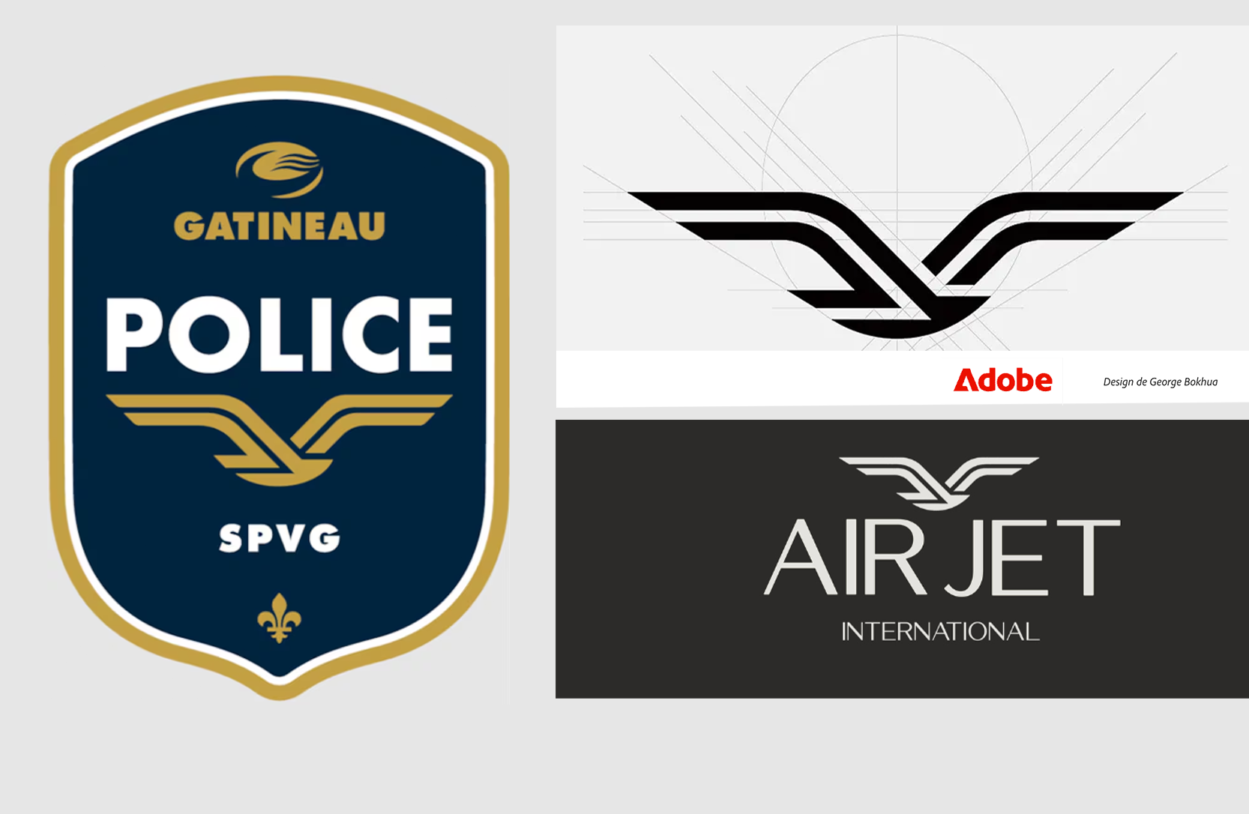
In April 2026, the Service de police de la Ville de Gatineau (SPVG) unveiled its new visual identity. Less than 24 hours later, it was pulled. The reason: the stylized bird at the centre of the logo came from a generic stock image library, identifiable on Adobe Stock and already used by a cargo transportation company. Ten months of work, an $8,000 institutional video, and an embarrassing press conference.
Beyond the local controversy, the situation raises a question the design industry often avoids addressing directly: can a logo legitimately be built around a pre-made symbol, whether from Adobe Stock, Canva, or any other visual library?
The short answer is no, at least not without fully understanding the consequences. The long answer is this article.
What the Adobe Stock licence actually says
Adobe Stock is one of the leading stock image platforms. Its standard licence is often perceived as broad and unrestricted. In reality, it comes with precise limitations that very few users read carefully.
The standard licence: what it allows
The Adobe Stock standard licence allows use across all media types, including print, digital, advertising, and websites, up to a maximum of 500,000 reproductions or views. For most standard marketing projects, that limit is more than sufficient. The licence is non-exclusive, perpetual, and worldwide. So far, nothing alarming.
The absolute restriction: logos and trademarks
Excerpt from Adobe Stock Terms of Use (2024):
“You may not register, or attempt to register, a trademark, service mark, or trade name that uses any Stock asset, in whole or in part.”
Adobe also explicitly states:
“You need to have complete ownership of the image you use for your company logo.
Because Adobe Stock only grants a right to use images and does not transfer the ownership,
these images cannot be used in or as a logo.”
There is no ambiguity here. Adobe Stock does not transfer ownership of an image, it only grants usage rights. Yet in order for a logo to be trademarked, the owner must hold full intellectual property rights to it. That is never the case with a licensed stock asset, regardless of the platform.
Even more troubling: Adobe Stock hosts nearly 1.5 million images tagged with the keyword “logo.” These visuals are clearly designed to resemble branding assets. Their presence on the platform creates confusion, even among professional designers, and the SPVG case illustrates this perfectly.
Even the extended licence changes nothing fundamental
Adobe also offers an extended licence, which removes certain limitations such as reproduction caps and resale restrictions. However, it does not change the core prohibition against using a Stock asset in a logo or trademark.
The reason is structural: the licence remains non-exclusive. Any other Adobe Stock user can purchase the exact same rights to the same image. A logo, by definition, must be unique.
“A logo, by definition, must be unique and exclusive to its owner. A stock image, by definition, never is. These two realities are incompatible.”
Fundamental principle of trademark law.
The Canva case: the illusion of ownership
Canva revolutionized access to design by allowing virtually anyone to create polished visuals without formal training. Its logo templates, in particular, appeal to many small businesses and organizations looking for a quick and affordable solution.
But Canva’s terms are even more restrictive than Adobe’s when it comes to logos.
What Canva explicitly states
Source: Canva Licensing Explained & Trademark Policy (2024)
“You cannot use any Free or Pro content from Canva's library in a trademark (except for fonts, basic shapes and lines).”
“Because Canva's Content library and logo templates are available to both Free and Pro users, one person cannot claim ownership over them. This means that you cannot use, or seek to register your designs as a trademark.”
Canva logo templates are intended for personal projects, such as labelling homemade beer or serving as a brainstorming starting point, not for building a true brand identity.
The platform is transparent about this, but very few users ever read the licensing policies. The issue is systemic: Canva’s interface is designed to make creation easy, not to warn users about the legal implications of what they create.
The only legal exception
Canva provides only one path for creating a potentially trademarkable logo on its platform: use only basic shapes and fonts from the free library, without any stock icons, illustrations, or photos. Alternatively, users may upload their own original assets for which they fully own the intellectual property rights.
In practice, this means using Canva strictly as an assembly tool, not as a source of creative assets.
Adobe Stock: What is allowed
✓
Use in advertising, marketing, and brochures
✓
Integration into websites and social media
✓
Printing up to 500,000 copies under the standard licence
✓
Use in presentations and reports
✓
Use in institutional videos
Adobe Stock: What is prohibited
✗
Use in or as a logo
✗
Trademark registration involving the asset
✗
Reselling the file alone or as the main product
✗
Transferring the asset to a third party without a separate licence
✗
Claiming ownership of the image
Canva: What is allowed
✓
Commercial use of designs for marketing purposes
✓
Sale of certain derivative products
✓
Logos based solely on user-uploaded original assets
✓
Use of fonts and basic shapes in logo design
Canva: What is prohibited
✗
Trademark registration using Canva Free or Pro assets
✗
Claiming exclusivity over a template
✗
Company logos based on Canva icons or illustrations
✗
Reselling stock elements as-is
The real-world consequences for organizations
Licensing restrictions are not just abstract legal concepts. They have direct and measurable consequences for brands. Here is what actually happens when a generic logo is discovered after deployment.
1. Inability to trademark the brand
The Canadian Intellectual Property Office, like trademark offices in most countries, requires applicants to own all rights associated with a trademark. A logo built on licensed stock assets fails that requirement by definition.
This means no legal protection can be obtained. Anyone may reproduce or imitate your logo without legal recourse.
2. Vulnerability to third parties
As demonstrated in the SPVG case, a generic logo may simultaneously be used by other businesses or organizations. If one of them registered the trademark first, your organization may suddenly be in violation and forced to immediately change its visual identity.
The associated costs, including communications, signage, official documents, and digital assets, can be substantial.
3. Institutional credibility at risk
For a public institution or established company, the revelation that a logo originated from a stock image library can seriously damage credibility. It raises questions about internal processes, governance standards, and the value placed on brand identity.
4. Emergency rebranding costs
A rushed withdrawal of a deployed visual identity creates very real expenses: recalling printed materials, updating signage, modifying official documents, redesigning websites, managing crisis communications, and funding an entirely new design process, this time properly supervised.

Real Case · Gatineau, 2026
SPVG: 10 months of work cancelled in 24 hours
The modernization process for the Gatineau Police Service visual identity took place over a ten-month period in collaboration with the municipal communications department. Two concepts were submitted internally to employees for validation. The selected logo incorporated a stylized bird intended to symbolize “the protection of the territory and its communities.”
Following the public unveiling, citizens and journalists quickly identified the symbol as a generic Adobe stock visual already used by Air Jet International, a cargo transportation company.
The result: immediate withdrawal of the new logo, a return to the previous identity, cancellation of a five-year rollout plan, and one confirmed expense, an $8,000 institutional video.
The communications director acknowledged that they had not realized the visual element originated from a commonly used stock image library. The City also concluded, after review, that it likely did not possess the necessary rights to use the visual.
Why this confusion is so widespread
The SPVG case is not an exception. It is the symptom of a structural misunderstanding fueled by several converging factors.
First, the platforms themselves contribute to the confusion. Adobe Stock references hundreds of thousands of visuals using the keyword “logo.” These assets are aesthetically designed for branding purposes, naturally misleading users. A “logo” label on a stock image does not mean it can legally function as one.
Second, the democratization of design tools, especially Canva, has created a generation of users designing logos without access to the legal knowledge needed to understand what they can and cannot do with those creations.
Finally, within institutions, graphic design is often delegated to general communications teams without specialized expertise in brand identity. Decisions are made by managers who may not fully understand the nuances of intellectual property law as applied to design.
“The question is not whether a tool is accessible. The question is what you are legally allowed to do with what it produces.”
What creating a truly original logo actually means
An original logo, in the legal and professional sense, is a graphic creation for which the creator, or the organization commissioning it, owns all rights in full.
That involves several conditions extending far beyond choosing an attractive visual.
The designer or agency must create the graphic elements from scratch, or use assets whose rights have been fully transferred, not merely licensed. The design contract must also include a complete copyright assignment to the client, which is not automatic, even in paid commissioned work.
The logo must also possess sufficient distinctiveness to meet trademark registration requirements.
This invisible, technical, and legally structured work is precisely what differentiates a professional brand identity designer from the simple use of a template or stock asset. This is not merely an aesthetic issue, it is fundamentally a matter of ownership.
What organizations should remember
📝 Sources : Adobe Stock License Terms (mai 2024) · Adobe Stock Known Issues & Limitations · Canva Licensing Explained · Canva Trademark Policy · Le Droit, mai 2026
Norelice Design
Let’s work
together
Looking for a graphic designer who brings intention into every project? Let’s connect.