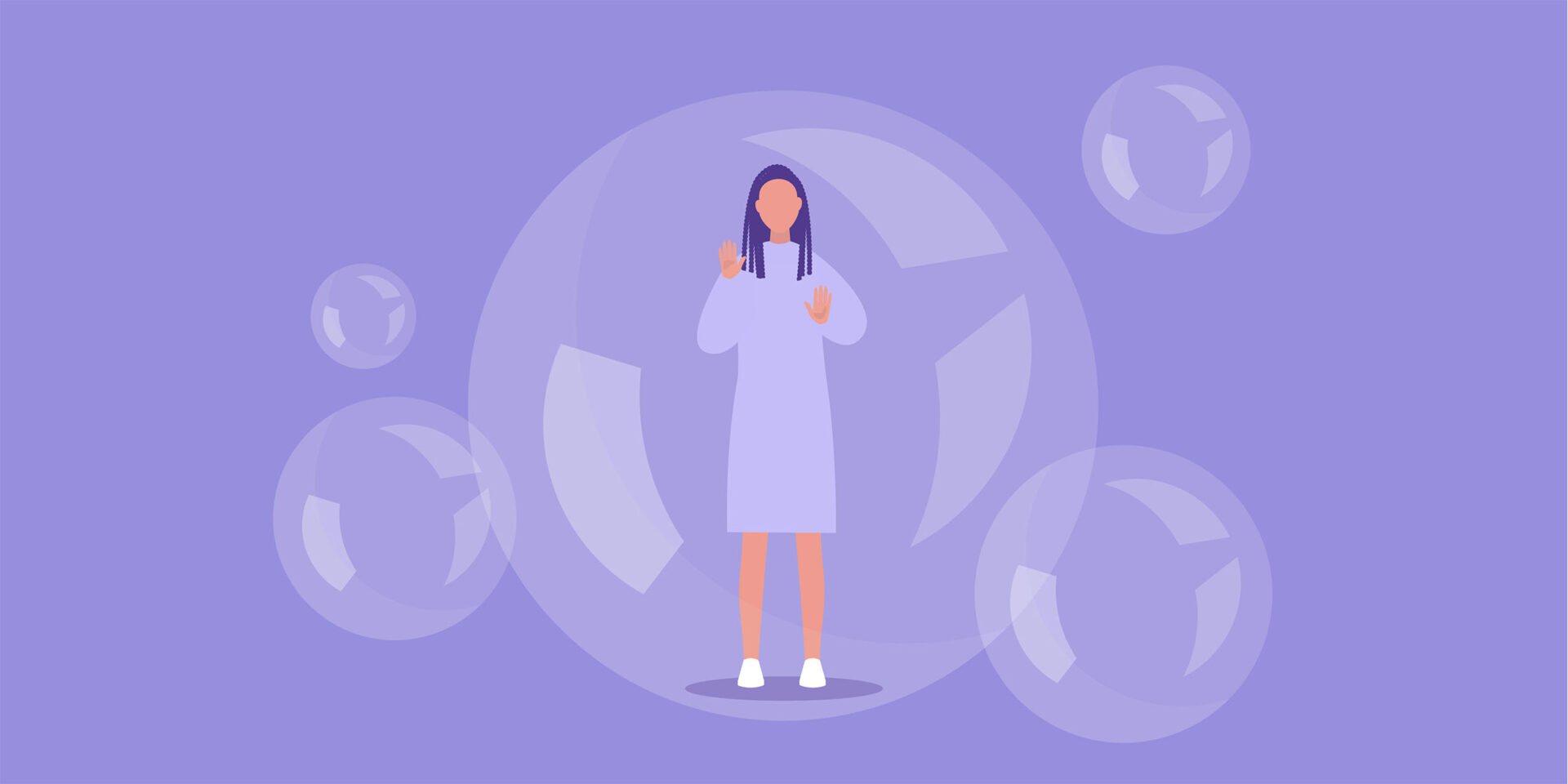
The algorithm does more than shape culture. It shapes your sense of what is possible.
Over time, it influences what you admire, what you pursue, and how you define success. In subtle ways, it can even shape who you become.

The Distorted Mirror of Visibility
There is a question that few creative professionals ask themselves openly:
Are my ambitions truly my own, or have they been shaped by what the algorithm chooses to show me?
Whether it’s Instagram, LinkedIn, TikTok, or any other platform, algorithms do more than distribute content. They determine what gets attention, who gets noticed, and what success appears to look like.
Every day, they influence what you see, who you admire, and which stories feel worth pursuing. The promise is personalization. The reality is often much closer to standardization.
Success begins to look increasingly similar: the entrepreneur showcasing a highly curated lifestyle, the creator documenting every achievement, the influencer perfecting a personal brand with the same discipline others devote to building a business.
"The algorithm promises personalization, but often delivers conformity. It doesn't reflect who you are, it shows you who is performing."
The result can be a subtle form of career drift. You continue creating, publishing, and building your business, but gradually move further away from your own interests, values, and ideas. Not because you consciously chose a different direction, but because the environment quietly nudged you there.
How Professional Aspirations Are Manufactured
We spend a great deal of time discussing personal branding.
We spend far less time examining how our aspirations themselves are shaped by the content we consume.
Yet that may be the more important conversation.
Social psychologists have long demonstrated that people evaluate success through comparison. We rarely judge our achievements in isolation. Instead, we measure ourselves against those around us.
Digital platforms amplify this tendency dramatically.
Instead of comparing ourselves to colleagues, peers, or members of our local community, we compare ourselves to a carefully filtered selection of the most visible people in our industry.
This creates a distorted picture of reality.
The visible success stories become so common in our feeds that they begin to feel normal. The lifestyles being showcased start to appear typical. Meanwhile, the thousands of successful professionals who are quietly doing meaningful work without broadcasting it become effectively invisible.
Related Concept
The availability heuristic, first described by Tversky and Kahneman, explains why we tend to overestimate the likelihood of events that come easily to mind.
When algorithmic feeds repeatedly expose us to exceptional success stories, those examples begin to define our expectations of what success should look like.
When Aesthetics Become Ideology
For designers and visual communication professionals, there is another challenge.
It is easy to confuse what performs well with what is authentic.
Some visual styles consistently generate engagement. Certain colour palettes attract attention. Particular layouts encourage shares and saves.
Algorithms reward these patterns and amplify them until they seem unavoidable.
Eventually, they stop feeling like trends and start feeling like standards.
But what performs well is not always what communicates effectively.
What goes viral is not always what lasts.
And what everyone else is doing is not necessarily what represents you.
Philosopher Byung-Chul Han argues that contemporary culture increasingly confuses visibility with value and exposure with existence.
If something cannot be posted, shared, or liked, does it still matter?
Algorithmic systems often imply that it does not.
Recognizing that assumption is the first step toward challenging it.
The Attention Economy
Herbert Simon and later Tim Wu helped popularize the concept of the attention economy: in a world of abundant information, human attention becomes the scarce resource.
Much of modern communication strategy is built around competing for that resource.
LIdentity Dark Patterns
Just as dark patterns in UX design encourage users toward choices that may not serve their interests, algorithmic systems can push creators toward behaviours that prioritize short-term validation over long-term growth.
Creativity Under Constraint
Research by Mihaly Csikszentmihalyi and Teresa Amabile suggests that excessive external pressures can reduce creative thinking.
When creative decisions become overly influenced by algorithmic performance metrics, originality often suffers.
Narrative Sovereignty
Narrative sovereignty is the ability to define your own story rather than allowing external systems to define it for you.
For professionals, this means maintaining ownership of your positioning, your values, and your vision of success.
Practical Ways to Reclaim Control
Revisit Your Original Influences — Think about the books, creators, movements, and ideas that inspired you before algorithms became a major part of your professional life.
Those influences often reveal more about your authentic interests than any curated feed ever could.
Separate Inspiration from Pressure — Ask yourself regularly: Do I genuinely want to create this, or do I feel compelled to create it because everyone else seems to be doing it? The answer is not always comfortable, but it is often revealing.
Create Without Publishing — Maintain a space for ideas that are not intended for public consumption.
Sketchbooks, notebooks, private experiments, and unfinished concepts often become the source of your most original thinking.
Creativity is different when it is not anticipating judgment.
Define Your Own Metrics of Success — Not every meaningful achievement can be measured through visibility.
Strong client relationships, long-term impact, personal growth, and mastery of a craft are all valuable forms of success, even when they generate no engagement metrics.
These invisible measures often prove more durable than public recognition.
"The goal is not to leave the platforms. The goal is to stop letting them define your direction."
A Strategic Advantage, Not Just a Personal Choice
For communication professionals, this conversation is about more than personal well-being.
It is about positioning.
In a marketplace flooded with algorithmically optimized content, genuine differentiation often comes from the places algorithms cannot easily reach.
The strongest client relationships, the most meaningful partnerships, and the most enduring projects rarely emerge from viral visibility alone.
They emerge from a distinctive perspective, a clear voice, and a body of work built with consistency over time.
Resisting algorithmic drift is not simply an act of self-preservation.
It is a professional strategy.
It is a decision to measure your value not by engagement rates, but by the depth, originality, and clarity of what you contribute.
Norelice Design
Let’s work
together
Looking for a graphic designer who brings intention into every project? Let’s connect.